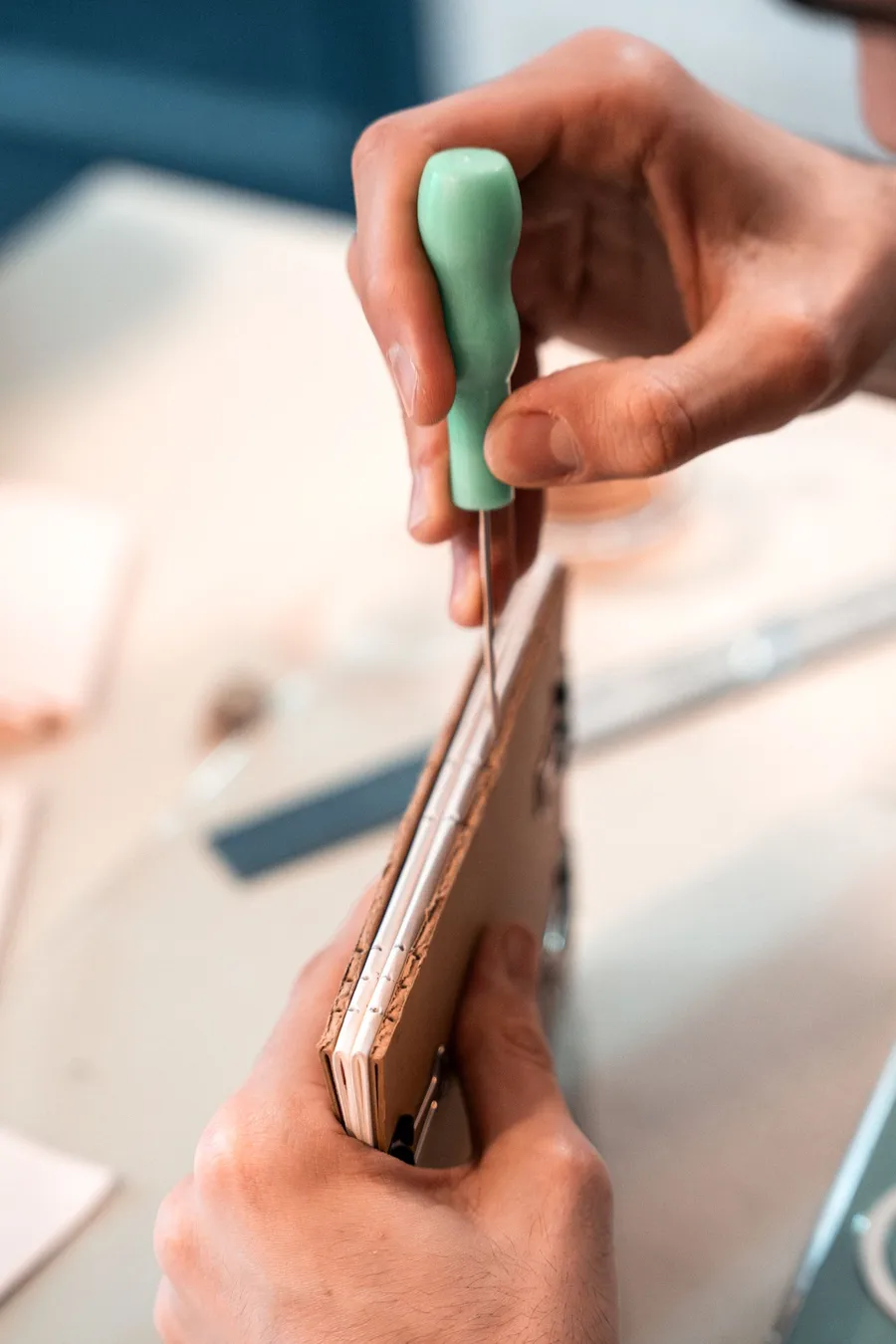
A cover made from thick card lies crisply over a folded set of pages. When a reader lifts the front, part of the inner paper follows it. The cover is asking the whole book to bend in a place the reader expected only one leaf to move. There is room in the finished dimensions for all the material. The problem shows up in movement rather than in size. A practice hinge makes that motion available for adjustment.
Fold a little sample of the wrapper with the planned stock inside it. Open the first page and let the cover move naturally on the bench. Observe the place that wants to turn first. It could be the marked fold, a flexible area just outside the one you planned, or the inner page trapped against a stiffer part of the cover. Make a temporary mark where movement starts. The usable hinge belongs to the behavior of the paper and the shape of the book together.
Compare a strong crease with a flexible zone
Produce a second wrapper that changes the area around the fold. One sample can be deliberately sharp and the other can let bend spread a little across a small region. Keep the paper and contents similar so the motion is easy to compare. Open near the front and at the center. Use the same hand position and keep the opening within the range of the finished work. See whether the force stays in the cover or transfers to the inner paper.
A crease that takes up very little room can suit a thin folded chapter that always opens on a table. A book to be carried and opened one handed may benefit from a different degree of stiffness. If the cover repeatedly closes on the hand, try a less rigid section before moving the shape of the whole book. If the cover collapses across the page when it is held upright, consider whether you can preserve firmness farther outward while leaving the hinge easier to bend.
Include the surface treatment
A printed, wrapped or pasted cover may behave differently from its plain paper proof. A second piece of material carries its own fold preference. Mark a printed test with an image crossing the turning part. Open and close the practice piece a few times and watch the place where the appearance changes. It may develop a visible white line or a wrinkle. You can adjust the placement of the design or test the cover combination before making a finished run.
Look at another opening if the book uses a heavier back than front. A flap, pocket or writing support can persuade the whole object to fold unevenly when opened from the rear. Try turning both covers with one hand resting on the adjacent leaves. Neither needs to feel identical, provided each achieves the movement readers are likely to ask. A specific test lets you protect the useful difference while finding where to free the stubborn part.
Preserve the chosen fold in the next sample
Label the trial that opens easily and keep it filled with its original mock pages. Side by side with a flat cover proof, the filled one tells you something about where bending happened. If you keep only the marked dimensions, it can be hard to reconstruct the softness of the opening. Add a short movement note that names an actual spread and how it lay when used.
Make a finishing comparison with a sample which has already been opened several times. Recheck where the front edge reaches when you lay it closed normally. The hinge needs enough return to protect its contents and enough movement to disappear from attention during reading. Mark the balanced sample for the edition and test any new stock around the same pages. The wrapper's motion belongs to the book every time it is opened.
Open the least flexible sample another time with an assembly already inside. Watch for the moment you start pressing with a second hand. Mark that spread to make the same comparison on the cover you expect to keep.