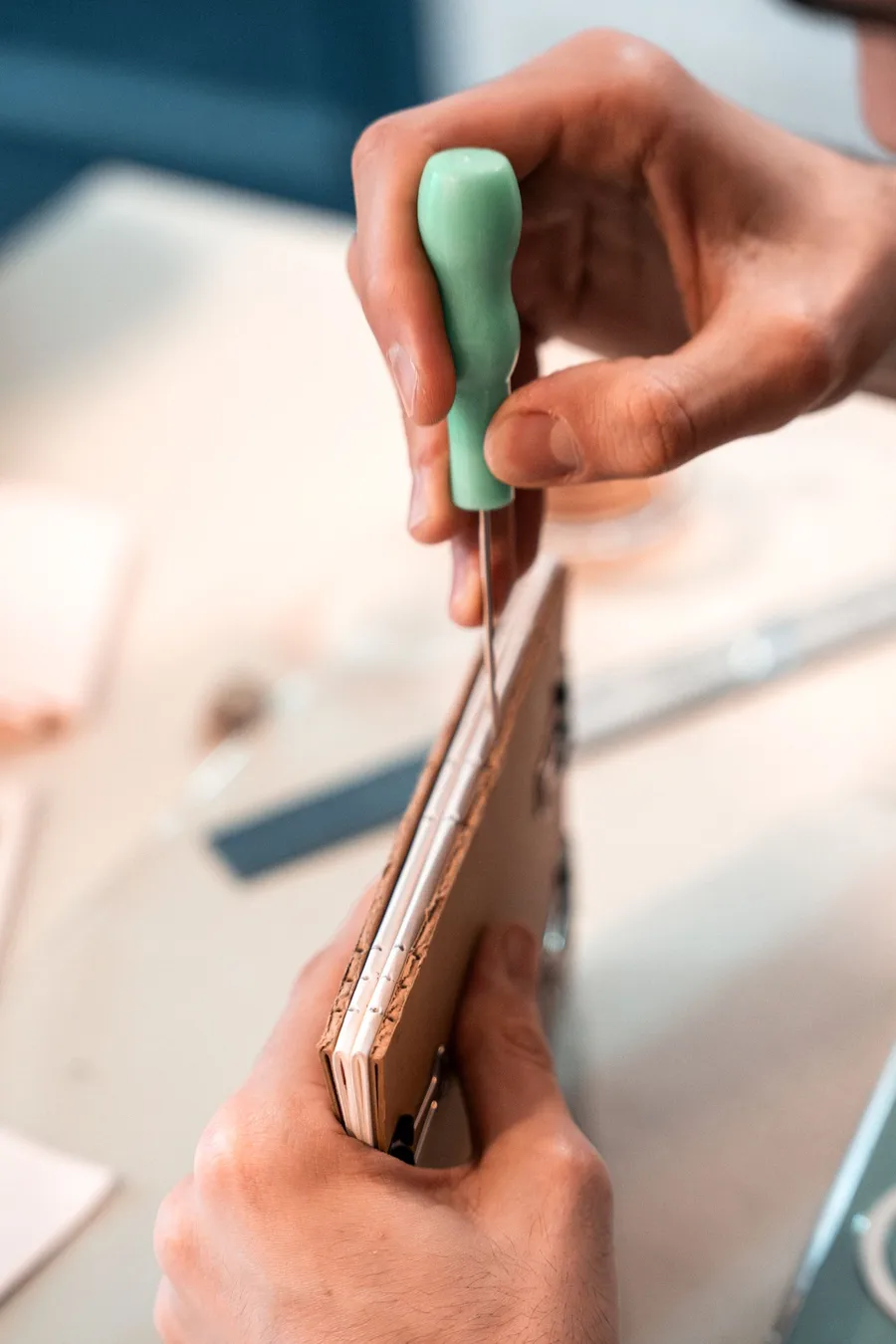
The cover blank and the inner pages share a measurement on a ruler. Set them beside each other and they look as though the edges will meet. Wrap the cover around a stack of folded leaves and its front edge stops a little short. The missing width lies in part of the trip across the spine. Thickness that once seemed to belong only to the inner pages has become a property of the outside.
Use extra sheets to make a test stack with the same number of folds and approximate thickness. Put the stack down and wrap a strip of the planned cover stock around it. Mark the front and back edges you actually want when the book is closed naturally. Leave a weak crease in the test strip or make a pencil mark where the spine turns. You can open it again and see the space that the cover needed on the inside.
Decide what the overhang protects
A small projection can make the outer edge easier to find. It can protect a slightly uneven stack from abrasion in ordinary use. A very broad projection on a thin pale cover can bend over in a bag. Put the booklet into a place it will often go and take it out a few times. A filing tray offers evidence about the edge sitting upright. A pocket or bag offers evidence about pulling the book by a corner. Count the real distance that it should extend in that use rather than adding a constant margin automatically.
Some covers are flush by intent. With a flush edge, compare positions at several heights because single folds can be uneven. Make a spare wrapper and mark its corner where the real stack visibly ends. A sharp mismatch at only one point could mean the stack shifted between folds rather than the cover being the wrong size. A small defect in a single leaf may be worth addressing on its own. Adjust the average of the cover only after understanding the shape it follows.
Let the cover open before retaining its measure
Open the trial around the middle and then close it without pressing. Watch where the folds want to settle. A crease made for a thinner stack can pull the cover away, leaving a little opening at the center. A tight wrap can push on a hinge each time you turn past the first page. Make another trial with the lines separated by a tiny change you can later identify. Repeat the closing action and compare the edges without adding pressure to rescue one.
Test the front near its ordinary use. A reading booklet can tolerate a cover that holds its position differently from a notebook placed flat for writing. If a stamped or printed design crosses the fold, make sure the folded front shows the part you intended. A strip works for sizing but won't reveal whether a graphic disappears around the rear edge. Mark the front with a plain rectangle of similar size and lift the sample in the way a reader picks it up.
Transfer the result to the bench copy
Mark a spine reference and opening direction on the unwrapped test. Record the paper stack used for this comparison rather than making the resulting number a permanent cover allowance. Add a note about which edge was measured when the booklet was lying closed. The next copy may use a stiffer paper or include an attachment. Put the test strip nearby and measure again with that stack if it changes.
One final comparison is to close a completed copy beside the trial. Check that sewing or assembly has made space where you expected it. A cover that arrives at each outer edge while allowing the book to open easily is doing a physical job hidden in the flat drawing. Keeping the strip in your records saves the measured route as well as the final size.
Check the long edge of the front wrapper with the booklet standing. A cover natural on a bench may settle in a different place if it is regularly carried upright.